
TerraSense Case Study: Making the Complex Understandable Without Oversimplifying It
Updated: Feb 20
How we evolved an AI SaaS brand over time

The Shift
By 2025, TerraSense had outgrown its early positioning.
What started as a highly respected R&D-driven company was moving into pre-commercialization, preparing to bring a full AI SaaS product to market. The technology was strong. The credibility was there. The brand, however, still reflected an earlier stage of the journey.
The challenge was not awareness.
It was translating a deeply technical product into a brand that could support commercialization without sacrificing trust, accuracy, or maturity.
The Challenge
TerraSense operates in an environment where marketing shortcuts do not work.
Messaging must land with engineers, procurement teams, government stakeholders, and non-technical partners
Over-marketing can be risky or constrained by confidentiality
Competing with multi-billion-dollar organizations means volume is not a differentiator
The real problem to solve was this:
How do you make a complex AI SaaS product understandable, credible, and compelling without oversimplifying it or overselling it?
Our Approach
This was not a brand restart. It was a brand evolution.
At this stage of growth, restarting the brand would have erased hard-earned credibility. Instead, we focused on elevating what already existed to reflect TerraSense’s current maturity, not where it had started.
Many companies in this position default to one of two mistakes: oversimplifying complex technology to chase adoption, or hiding behind technical language to avoid clarity. We avoided both.
Key decisions shaped the work:
Evolve the brand rather than rebrand from scratch
Prioritize clarity over cleverness in messaging
Build a narrative system that could adapt to different audiences without fragmenting
Design a visual language that works across digital platforms, physical spaces, and in-person conversations
Avoid trend-driven AI visuals in favour of longevity and trust
Bring the people behind the technology forward, not just the product
Every decision was made with long-term scalability in mind.
The Work
The work spanned research, strategy, creative direction, and execution, all anchored in a single narrative framework.
This included:
Positioning and narrative architecture
Evolution of the visual brand language
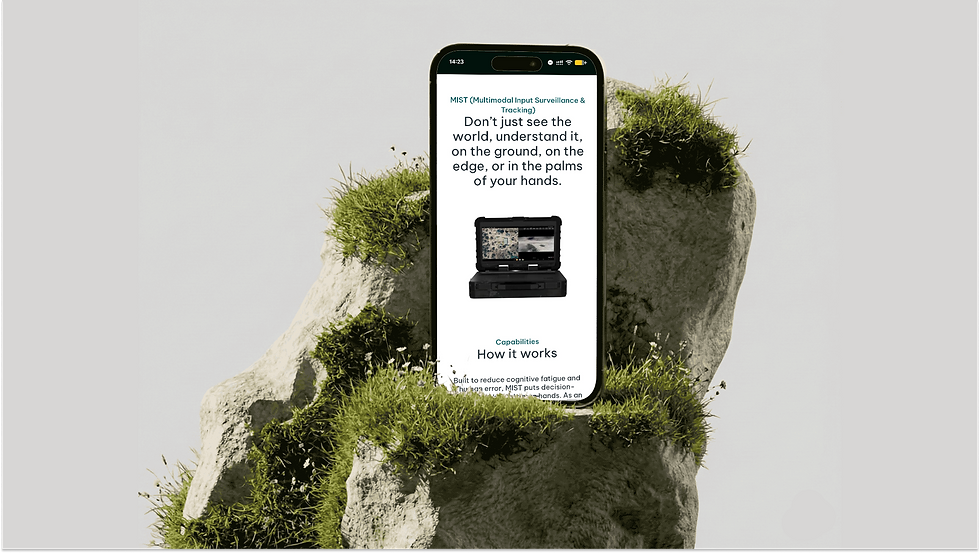
Full website overhaul aligned with product maturity
Event and conference strategy, including booth and spatial design
Creative direction for video and photography
Content planning that educates without overwhelming
Updated brand and communication guides used across teams
Branded materials and merchandise designed for real-world use
Internal alignment to ensure consistency across touch points
Rather than isolated deliverables, the focus was on building a system that could grow with the company.

The Outcome
Following the brand and website relaunch:
Website traffic increased by 2,792% since the launch of the new design
Engagement and foot traffic increased at the largest industry conference of the year
There was a notable rise in unsolicited job applications, even without active openings
But the most important outcome was not visibility.
It was alignment.
Internal teams, external partners, and audiences were finally speaking the same language about what TerraSense does, how it fits into the ecosystem, and why it matters.
Why This Work Matters
This case study isn’t about one company. It’s about what happens when marketing meets complexity.
We work with products that don’t fit into neat categories, require precision in language, need to speak to multiple audiences at once, and can’t rely on hype to build trust.
In those situations, creative thinking isn’t about decoration. It becomes a strategic tool we use to help teams process complexity, make deliberate decisions, and present challenges in a form people can actually engage with.
If your company builds complex technology and needs clarity without oversimplification, this is the kind of work we’re built to handle.